

The Paul Conroy everyone should know about

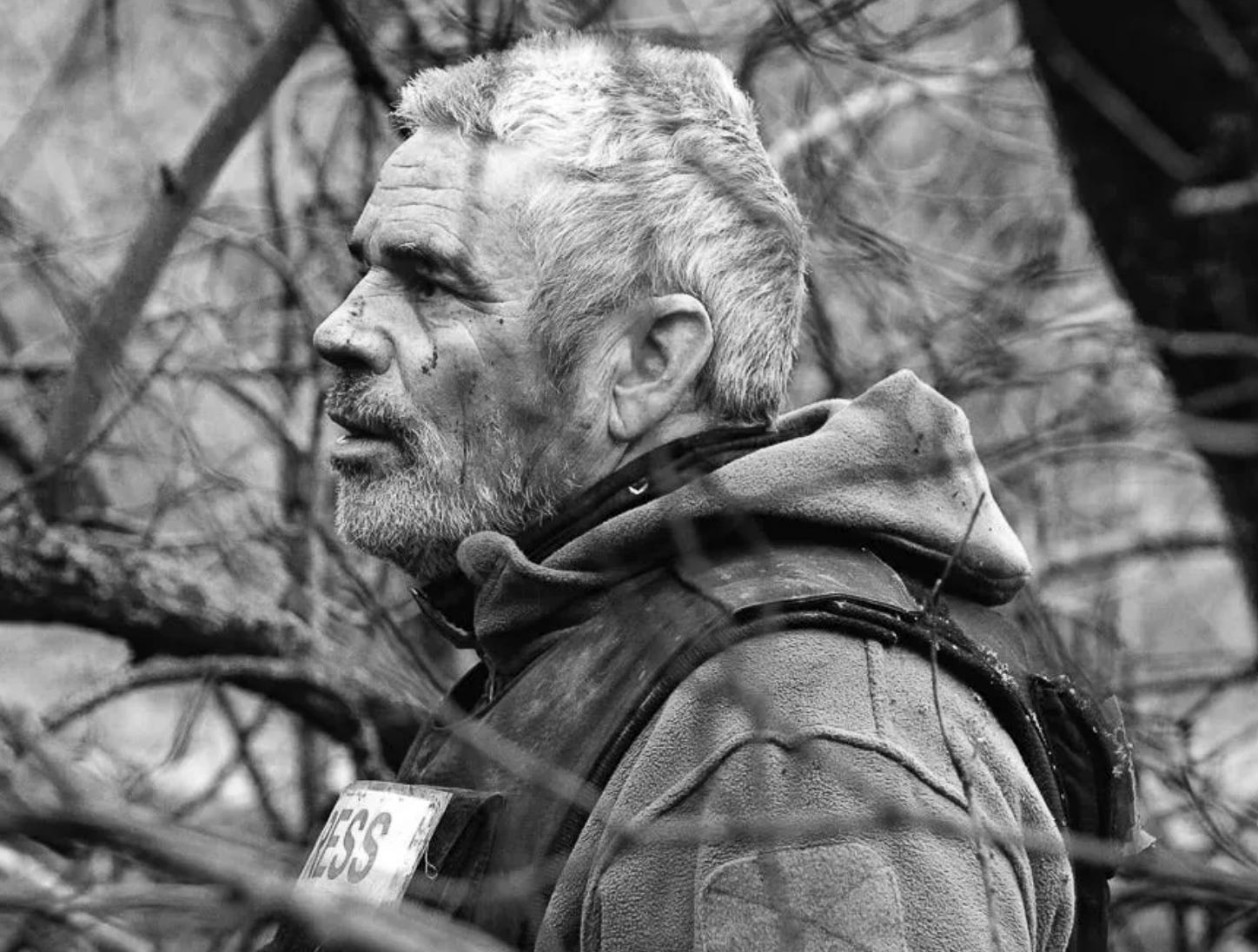
If you search for the name “Paul Conroy” online, the first person who comes up is a former American soccer player. Next up: the founder of a protective gear company. Then an associate professor emeritus at a Michigan university.
The man by that name who was an accomplished war photographer, and who died of a heart attack last week, doesn’t even show up in the full first page of returns.
This oversight is bewildering for anyone who knew the photojournalist, yet I doubt it would have much bothered Conroy, given that his driving aim was to illuminate the lives of others who were caught up in armed conflicts. Conroy, who died at age 61 on Feb. 28, 2026, published one book and it wasn’t a memoir but a biography of his friend and fellow conflict photographer Marie Colvin, who was killed in Syria in 2012.
That was how Conroy rolled, focusing on the challenges that others face. For the last four years he had covered the war in Ukraine and documented his experience on the Substack “The Kramatorsk Diaries,” in which he mused about the fighting and its geopolitical backdrop and shared videos and an album of songs that he recorded during a period of relentless shelling.
Among the ranks of conflict photographers, there are two distinct types: Those who show up in dangerous places to capture sensational “bang-bang” photos and get a dose of adrenaline, then move on, and those whose aim is to share with the rest of us the experiences of people caught in extreme circumstances—to “explain the world to the world,” as the late photojournalist Tim Hetherington—whose own death connected me to Conroy—put it.
Both Conroy and Colvin were in Misrata, Libya when Hetherington was killed, along with photojournalist Chris Hondros, in a mortar attack in April 2011. Two other photographers, Guy Martin and Michael Brown, were seriously injured in the attack and several Libyan rebels died, though none were named in media reports, if they were mentioned at all.
In 2013, I published a biography of Hetherington, Here I Am, simultaneous to the release of Sebastian Junger’s documentary film about him, Which Way is the Front Line from Here? I knew Hetherington through Junger, and while researching the book, I traveled to Misrata to find out what happened. I spoke with everyone I could find who was there that day—at the scene of the attack, in the pickup truck that transported Hetherington to the city’s one functioning hospital, inside the al Hekma hospital itself and in the besieged city afterward.
Hetherington had most likely already died by the time the pickup truck reached the hospital, though medical personnel tried valiantly to resuscitate him. Conroy and Colvin were both at al Hekma at the time, though no one I spoke with mentioned either being present at the time of Hetherington’s death. I later spoke with another conflict photographer, André Liohn, with whom I bunked during my time in Misrata, about an article in Vanity Fair that suggested Hetherington died in Colvin’s arms.
Colvin had arrived in Misrata on the day of Hetherington’s death aboard the same boat that would later carry his body back to his native England. As far as I know, their paths never crossed in Misrata while he was alive. Colvin would herself be killed the following year in what was almost certainly a targeted attack in Homs, Syria that also killed French photojournalist Rémi Ochlik. Conroy was with Colvin in Homs and was seriously injured in that attack, as was another journalist, French reporter Édith Bouvier.
These were all fascinating people, many of whom were destined to die in the course of their work. Conflict reporting is obviously an extremely dangerous profession, and it’s getting more so. According to data compiled by the Committee to Protect Journalists, a record 129 journalists were killed in armed conflicts in 2025, two-thirds of them by Israeli forces.
Liohn, who was in Misrata during the period that Hetherington and Hondros were killed, put me in touch with Conroy to see what he had to say about the reference to Colvin in the purported death scene. When I messaged him, Conroy observed that the article was about Colvin and was “full of holes” and “a very sloppy piece of journalism, to say the least.” He added, “I can confirm that Tim did not die in Marie’s arms. We were at Hekma hospital at the time, but Tim was already dead when we heard the news.” Junger wrote his own article about Hetherington’s death for Vanity Fair and correctly documented the facts of Hetherington’s death. Conroy and I communicated sporadically after that initial exchange, and although we never met, he thoughtfully recommended “What Happened” on his own Substack site.
Journalist Marie Brenner, who wrote the August 2012 Vanity Fair article, later published a book about Colvin, A Private War, which would be the basis for a movie by the same name in which Conroy’s character is played by Jamie Dornan. Hetherington appears, after a fashion: For some reason, he is represented as a composite photojournalist character.
In the movie (and, presumably, the book, though I have not read it), Colvin meets Conroy, a freelance photographer and former British artillery officer, in a U.S. military staging area prior to the 2003 invasion of Iraq, and she takes him along in search of a mass grave of hundreds of Iraqi dictator Saddam Hussein’s victims. Conroy had gained some notoriety among journalists for trying to get into Iraq aboard a homemade raft, along with a New York Times stringer, after having cobbled the vessel together in their Syrian hotel room. The two were intercepted by Syrian authorities and arrested but were soon released.
Hearing about that episode, Colvin tracked down Conroy and the two reportedly went out drinking into the wee hours (oh, to have been a fly on the wall that night). Conroy told Time magazine that he didn’t see Colvin again for seven years.
Conroy noted that the movie’s character Norm Coburn was loosely based on Hetherington, whom he and Colvin knew and who was a contributing photographer to Vanity Fair. The Time article notes that in both the movie and in real life Conroy and Colvin came close to leaving the besieged, rebel-held city of Homs before the fateful attack but that Colvin decided she needed to go back.
According to Conroy, they had been smuggled out of Homs in anticipation of a regime assault, and after the attack failed to materialize, decided to return. In his telling, they stopped at the mouth of a tunnel leading back into the city and he warned Colvin that he had “a really bad feeling about this. It doesn’t feel right, and I’ve never gone against my instinct.” Colvin reportedly said she was going back into the city regardless, so Conroy decided to accompany her for what turned out to be her last assignment.
Conroy’s own last assignments would be in Ukraine and Cuba. He died at his home in the UK. On March 1, 2026, Liohn posted on Facebook: “Our brother, our mate, Paul Conroy, has left us. Paul was funny, intelligent, sensitive, loud, generous, irreverent, authentic, and deeply affectionate.”
Liohn added a telling anecdote: “I remember the day I went to visit him in the hospital in London, after he had been rescued from Syria, where he had nearly lost a leg in the attack that killed our friends Marie Colvin and Rémi Ochlik. I was afraid I would find him broken in spirit, and hoping he would recover as soon as possible, I brought him an apple.
“But when I walked into his room, I found something entirely different from what I had expected. The room was full of whisky bottles, and we spent the afternoon drinking, laughing, and sharing our fondest memories of Marie and Rémi.
“People like Paul are extraordinarily rare. He will be missed beyond measure.”
Conroy was born in Liverpool, England in 1964, and was a founding member and trustee of the Frontline Club, a London hub for war journalists. He documented conflicts in the Balkans, the Middle East, Libya, Congo, Afghanistan and finally, Ukraine. He most recently reported from Cuba in the aftermath of the United States operation in Venezuela.
Following his death, his brother Alan Conroy told the BBC, “He did all his life what he wanted to do to make a difference—he found great pleasure in exposing wrongs.”
In the 2018 documentary film Under the Wire, which chronicles Conroy’s escape from Homs, he says he only realized the extent of his injuries after he returned to the UK.
“Obviously, I knew I had a huge hole in the back of my leg,” Conroy says. “But in London I found out I also had a great big piece of shrapnel wedged under my kidneys. I had 23 operations on my leg and others on my abdomen and back. I was in hospital for five months.”
Of the Syrians in Homs, Conroy says in Under the Wire, “These beautiful people who were being slaughtered, I wanted to tell their story.”
Conroy never fully recovered from the injuries he received in Homs, yet when Russia’s invasion of Ukraine began he led the Frontline Club’s initiative to train Ukrainian journalists in battlefield first aid.
“Even at the end of his life, Paul was doing what he had always done: traveling towards the story, not away from it,” observed Jon Williams, director of the Rory Peck Trust. “For those of us who believe journalism matters, his life stands as a reminder of what that belief looks like in practice. He showed up. He stayed. He bore witness.”
Conroy leaves behind his wife, three sons and several grandchildren.
Image: Paul Conroy (via The Kramatorsk Diaries)